
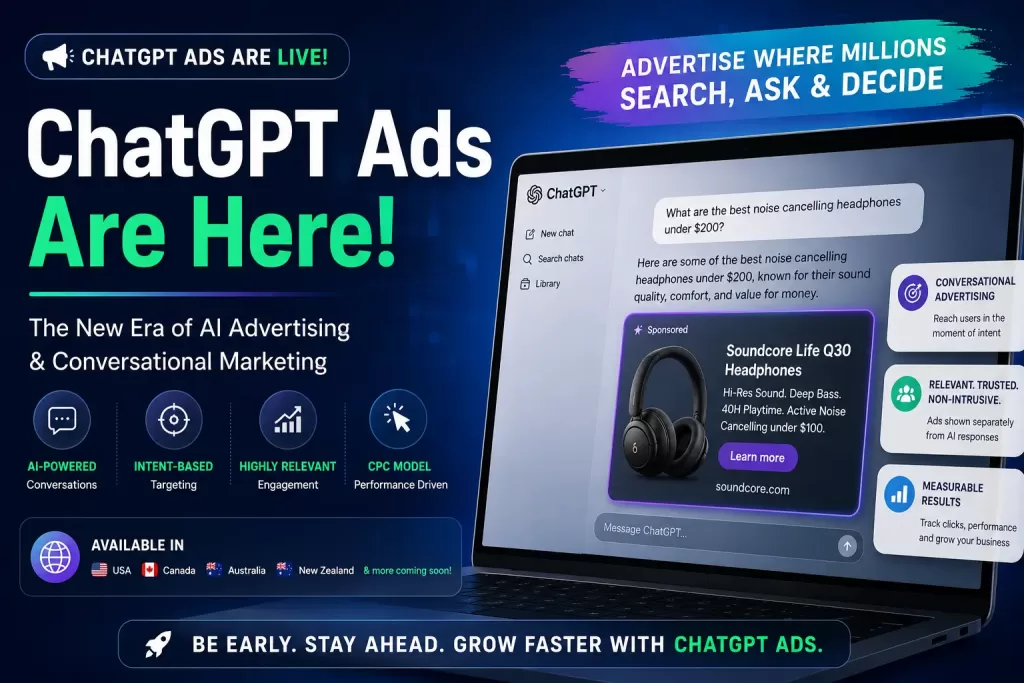
Artificial intelligence is rapidly changing digital marketing, and now the biggest shift has officially arrived: ChatGPT ads are live.
OpenAI has officially started rolling out ads inside ChatGPT, giving businesses a brand new way to reach users through AI conversations instead of traditional search engines. This launch marks the beginning of a new era in AI search ads and conversational advertising.
If you’re searching for:
- “How to run ads on ChatGPT”
- “ChatGPT advertising”
- “OpenAI advertising”
- “AI ads platform”
- “How to advertise on ChatGPT”
…this guide explains everything you need to know.
What Are ChatGPT Ads?
ChatGPT ads are sponsored placements shown below AI generated responses inside ChatGPT. These ads are clearly labeled as “Sponsored” and are visually separated from the AI answers.
Unlike Google Ads, which rely heavily on keywords, ChatGPT advertising focuses on:
- Conversation context
- User intent
- Research behavior
- AI driven relevance
This makes ChatGPT one of the first large scale conversational advertising platforms.
Are ChatGPT Ads Live Right Now?
Yes. OpenAI officially confirmed that ChatGPT ads are now being tested and rolled out in select countries.
OpenAI also launched:
- A beta self-serve Ads Manager
- CPC (cost-per-click) bidding
- Expanded advertiser tools and reporting features
This means businesses can now begin preparing to run ads on ChatGPT through OpenAI’s growing ad ecosystem.
Which Countries Are Eligible for ChatGPT Ads?

According to OpenAI, ChatGPT ads are currently rolling out in:
- United States
- Canada
- Australia
- New Zealand
OpenAI also announced upcoming expansion into:
- United Kingdom
- Brazil
- Mexico
- Japan
- South Korea
At the moment, ChatGPT Ads Manager is primarily rolling out in the U.S. market.
Who Can See ChatGPT Ads?
Currently, ads mainly appear for:
- Free plan users
- ChatGPT Go users
Ads do NOT currently appear for:
- Plus users
- Pro users
- Enterprise users
- Business accounts
- Edu accounts
How Do ChatGPT Ads Work?

Conversational Targeting
Instead of targeting only keywords, OpenAI advertising uses:
- Current chat topics
- Conversation intent
- Previous interactions (if personalization is enabled)
For example:
Someone researching recipes may see grocery or meal kit ads.
Someone asking about website design may see digital marketing or hosting ads.
This creates highly relevant AI search ads.
How to Run Ads on ChatGPT
Many marketers are now searching:
- “How to advertise on ChatGPT”
- “How to run ads on ChatGPT”
- “ChatGPT advertising platform”
Here’s the current process.
Step 1: Join the OpenAI Ads Program
Businesses can currently access ChatGPT advertising through:
- Agency partnerships
- OpenAI beta Ads Manager
- Waitlist access for advertisers
Step 2: Create Conversational Ad Content
Traditional banner style copy may not perform well.
Instead:
- Focus on helpful messaging
- Match user intent
- Use conversational language
- Avoid aggressive sales tactics
Step 3: Choose CPC Bidding
OpenAI recently introduced:
- Cost-per-click bidding
- Campaign management tools
- Performance reporting
This makes ChatGPT advertising more similar to Google Ads while still being conversation-focused.
Step 4: Track Performance
Early advertiser reporting currently includes:
- Impressions
- Clicks
- Engagement metrics
Advanced conversion tracking is still evolving.
Pros of ChatGPT Ads
1. High User Intent
Users inside ChatGPT are often actively researching solutions, making ads highly targeted.
2. Lower Competition
Compared to Google Ads and Meta Ads, ChatGPT advertising is still in its early stages.
This creates a strong first mover advantage.
3. Better Contextual Relevance
ChatGPT understands full conversations, not just keywords.
This allows smarter ad placement.
4. Growing AI User Base
ChatGPT now has hundreds of millions of users globally.
As AI adoption grows, conversational advertising will become a major marketing channel.
5. Future of AI Search Ads
Many experts believe AI assistants could eventually compete directly with traditional search engines.
Brands entering early may benefit significantly long-term.
Cons of ChatGPT Ads
1. Limited Availability
The platform is still rolling out gradually.
Not all businesses can access ads yet.
2. Limited Analytics
Compared to Google Ads:
- Attribution tools are still basic
- Conversion tracking is limited
3. Privacy Concerns
Some users worry about:
- Personalized targeting
- AI conversation analysis
- Data privacy
OpenAI states advertisers do NOT receive:
- Chat history
- Personal data
- Email addresses
- Precise locations
4. Restricted Ad Categories
OpenAI currently blocks ads related to:
- Politics
- Health
- Financial services
- Dating services
5. User Trust Challenges
Some users dislike ads inside AI conversations because ChatGPT feels more personal than traditional search.
ChatGPT Ads vs Google Ads
Feature | ChatGPT Ads | Google Ads |
|---|---|---|
| Targeting | Conversation intent | Keywords |
| Format | Conversational | Search/display |
Competition | Low | High |
| Funnel Stage | Research phase | Purchase phase |
| Personalization | AI-driven | Search-based |
| Experience | Chat-based | Search results |
The best strategy is often combining both:
- ChatGPT Ads → Awareness & discovery
- Google Ads → Conversions & sales
Why ChatGPT Advertising Matters for Businesses
The rise of AI assistants is changing user behavior.
Instead of searching:
“best digital marketing agency”
Users now ask:
“Which marketing agency is best for small businesses?”
This creates a major opportunity for brands investing in:
- AI SEO
- Conversational content
- AI search optimization
- ChatGPT marketing strategies
Businesses that adapt early may gain significant visibility advantages.
ChatGPT Marketing Strategy for 2026
To succeed with ChatGPT advertising:
Create Helpful Content
AI systems favor useful, informative content.
Optimize for Conversational Search
Use natural-language questions and answers.
Combine SEO + AI Advertising
Use:
- SEO
- Google Ads
- ChatGPT Ads
- Social media marketing
Together for maximum visibility.
Build Brand Authority
Trust and credibility matter more than ever in AI-powered search.
Future of Conversational Advertising
The future of digital marketing is shifting from:
Keyword search to AI conversations
This means:
- AI search ads will grow rapidly
- Conversational advertising will become mainstream
- Traditional SEO will continue evolving
ChatGPT advertising may become one of the most important digital marketing channels of the next decade.
Final Thoughts
ChatGPT ads are no longer just a rumor — they are officially live and expanding globally.
For marketers and businesses, this is a major opportunity to:
- Reach users earlier in the buying journey
- Advertise inside AI conversations
- Build visibility in the next generation of search
Companies that start experimenting now may gain a powerful long-term advantage as AI advertising continues to grow.
Submit the form
Latest Blogs
Starbucks Success Story: How a Small Seattle Coffee Shop Became a Global Brand
FAQs About ChatGPT Ads
ChatGPT ads are sponsored placements displayed below AI-generated responses inside ChatGPT conversations.
Yes. OpenAI has started rolling out advertising access through agency partnerships and a beta Ads Manager platform.
Currently:
- United States
- Canada
- Australia
- New Zealand
Expansion is planned for:
- UK
- Brazil
- Mexico
- Japan
- South Korea
ChatGPT ads are excellent for awareness and conversational targeting, while Google Ads remain stronger for direct conversions.
No. OpenAI states ads are separate from ChatGPT responses and do not influence answers.