"How long does SEO take to work?" It's the question every business asks before investing in search, and the one that gets the vaguest answers. The truthful answer is "it depends," but it depends on things you can actually assess.
This guide explains what a realistic SEO timeline looks like, what speeds it up or slows it down, and what you should see along the way.
The short answer
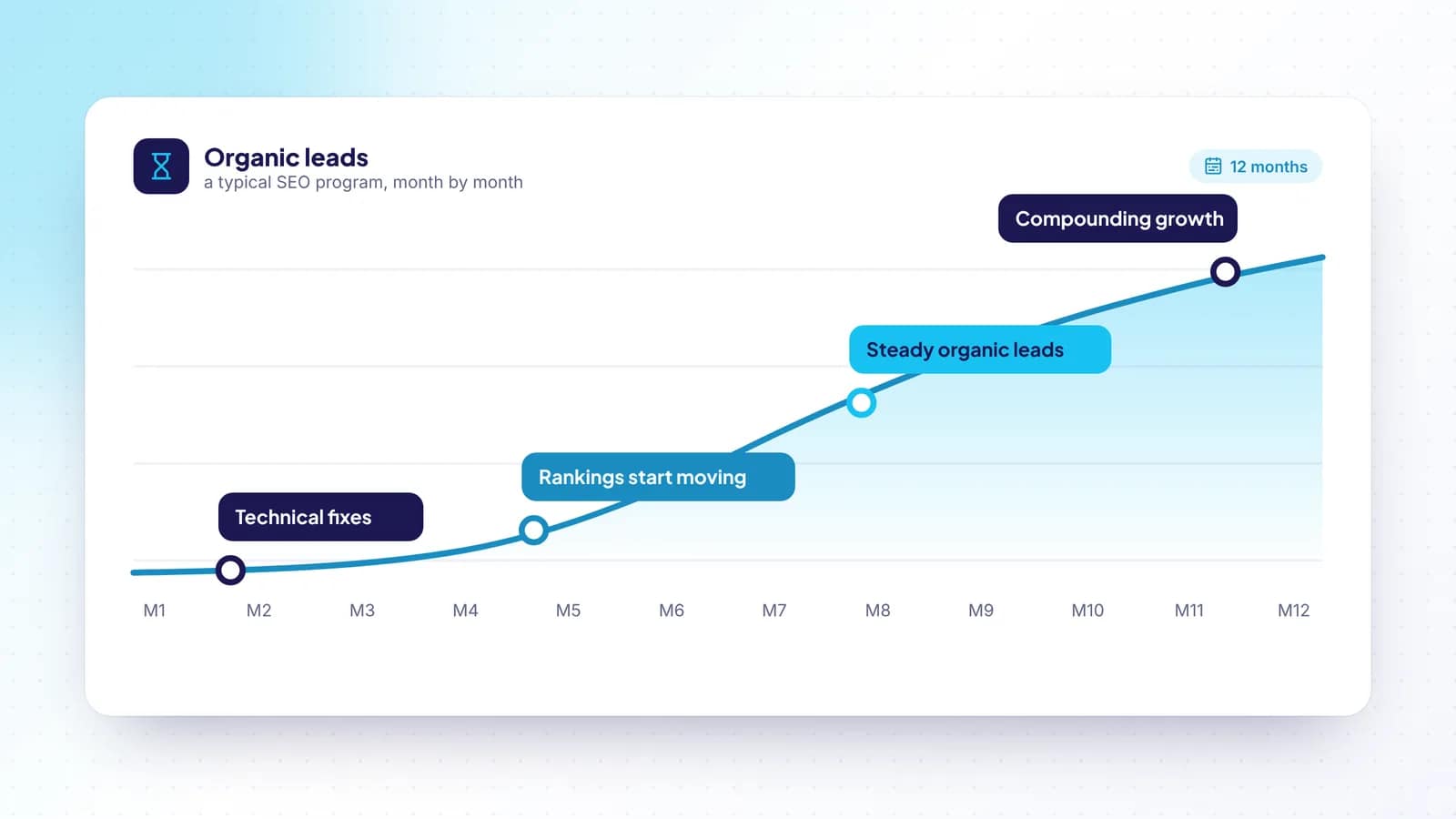
Google itself says that in many cases it can take four months to a year from when changes begin until a business sees the benefit. Some improvements show up within weeks, especially technical fixes and Google Business Profile updates. Ranking for competitive searches usually takes several months of steady work, and results keep compounding after that.
Anyone who guarantees a #1 ranking in a set time is guessing, because no one controls Google's results.
A typical SEO timeline
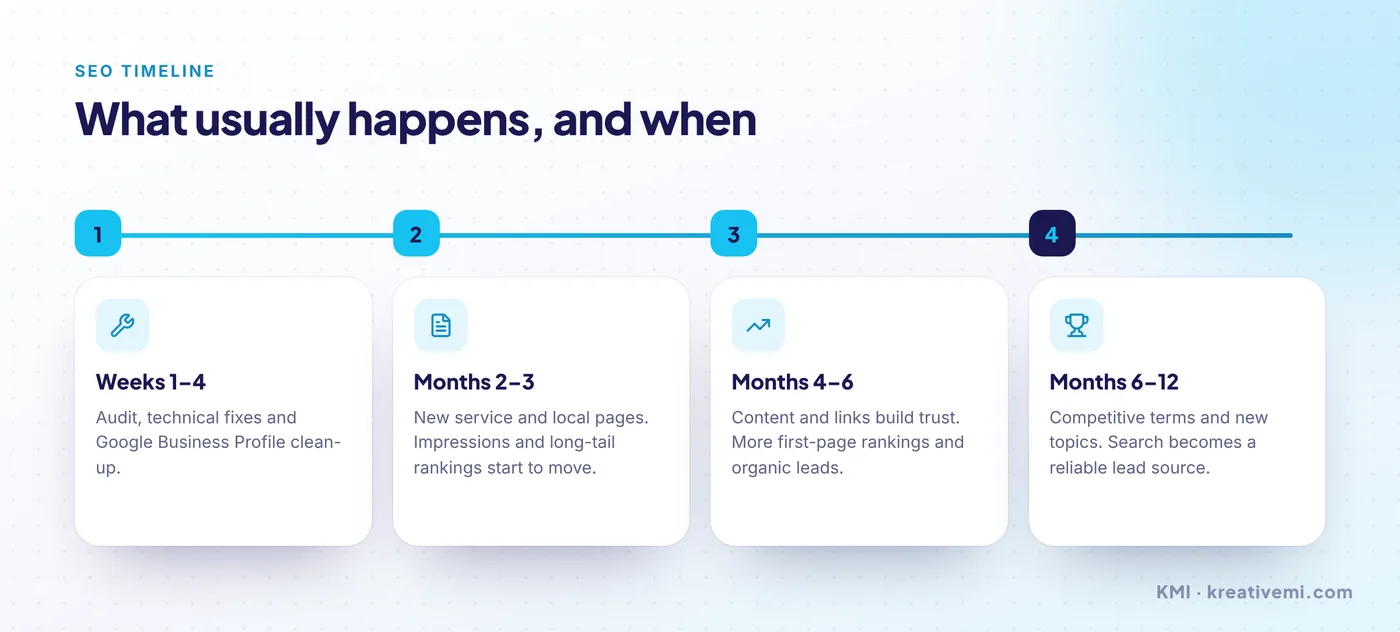
Every site is different, but most SEO programs move through similar stages:
| Stage | What happens | What you can expect to see |
|---|---|---|
| Weeks 1–4 | Audit, keyword research, technical fixes, Google Business Profile clean-up | Pages indexed correctly, errors fixed, a clear priority plan |
| Months 2–3 | New and improved service pages, local pages, internal linking, early reviews | More impressions in Google Search Console, long-tail and map rankings starting to move |
| Months 4–6 | Content and links build up, pages gain trust | More first-page rankings, steady growth in organic visits and leads |
| Months 6–12 | Competitive terms, expansion into new topics and areas | Organic search becoming a reliable lead source |
What affects how long SEO takes
How competitive your market is
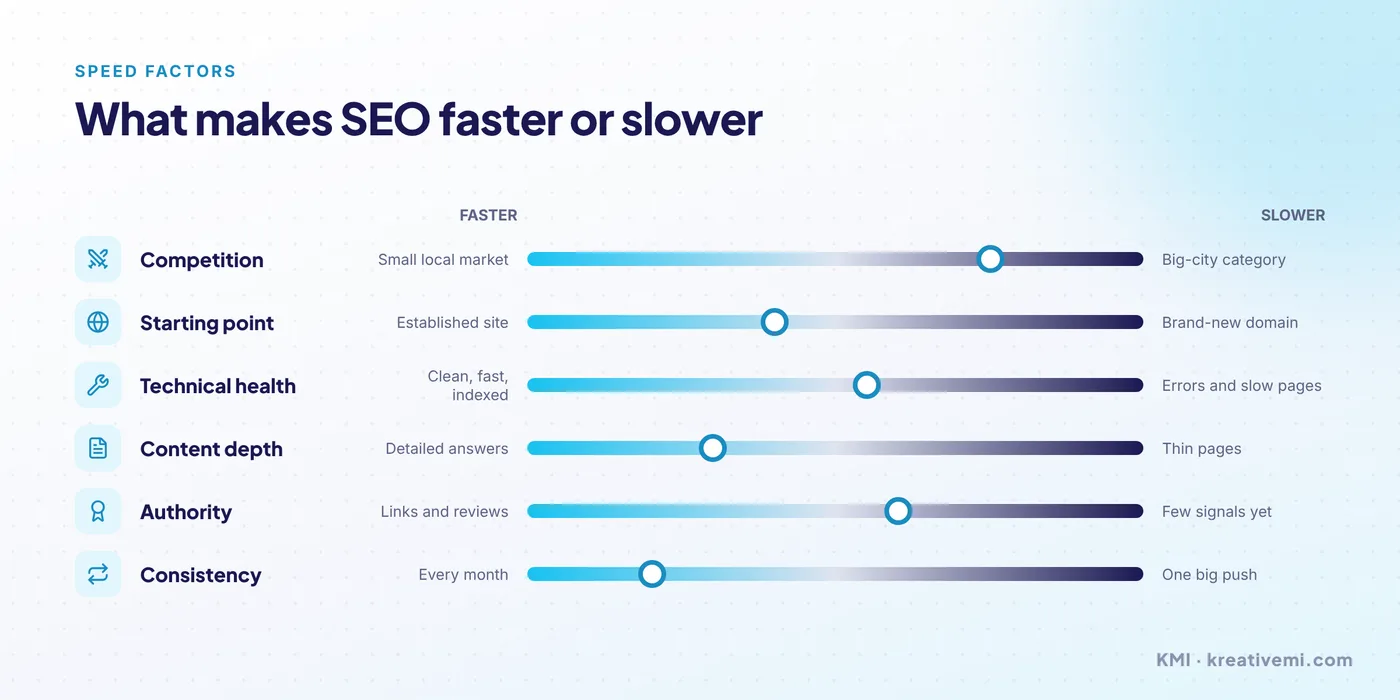
A roofing company in a small town can move faster than a law firm in a major city. If national brands and well-funded competitors already own the first page, it takes longer to earn a place next to them.
Where your website starts
A new domain with few pages and no links starts from zero. An established site with technical problems can often see faster gains, because fixing what's holding it back unlocks trust it already has.
Technical health
If Google can't crawl, render or index your pages properly, nothing else works. Slow pages, broken links, duplicate content and missing redirects after a redesign all delay results.
Content depth and quality
Thin pages rarely rank. Pages that answer real questions in detail, written for your customers, rank faster and convert better.
Authority and reviews
Links from reputable sites, mentions in local media and a steady flow of reviews show search engines that real people trust you. These build over time and are hard to rush.
Consistency
SEO is cumulative. A business that publishes, improves and earns links every month will usually outrun one that does a big push and then stops.
How to tell if SEO is working before rankings arrive
You don't need to wait a year to know if you're on track. Watch these signals in Google Search Console and your analytics:
- Impressions rising: Google is showing your pages for more searches, even before clicks follow.
- More keywords ranking: especially on pages two and three, which tend to move up next.
- Map pack visibility: for local businesses, more views and calls from your Google Business Profile.
- Organic leads: calls and forms from organic search, tracked separately from ads.
How to get SEO results sooner
- Fix the technical basics first. It's the fastest way to unlock existing potential.
- Start with searches close to revenue. "Emergency plumber near me" brings leads sooner than a general how-to article.
- Optimize your Google Business Profile. For local businesses, map rankings can move faster than organic ones.
- Run Google Ads while SEO builds. Ads bring leads now and show which keywords convert, so you know which pages to prioritize.
- Think beyond Google. More customers now ask ChatGPT or Gemini for recommendations, and the same clear content helps there too. See our guide to showing up in ChatGPT search.
What about a website redesign?
A redesign or move to a new platform can cause a temporary dip in rankings while Google recrawls the new pages, even when everything is done correctly. Mapping every old URL to its new page with 301 redirects, keeping important content and resubmitting your sitemap keeps that dip short. Our website redesign checklist covers the steps.
Frequently asked questions
How long does SEO take to show results?
Google says it often takes four months to a year for SEO changes to show their full benefit. Technical and Google Business Profile fixes can help within weeks, while competitive keywords usually take several months of consistent work.
How long does local SEO take?
Local SEO is often faster than national SEO. Map pack and "near me" rankings can improve within one to three months once your Google Business Profile, reviews and local pages are in good shape, depending on how competitive your area is.
Why is my website not ranking after a redesign?
Google needs time to recrawl and re-evaluate new pages. A short dip is common. Check that old URLs redirect to the right new pages, that the new pages are indexed and that your sitemap has been submitted in Google Search Console.
Can SEO results be guaranteed?
No. Search engines decide rankings, and their algorithms change. A good SEO partner explains its plan, reports progress monthly and measures results by calls and leads, not promises.
Should I do SEO or Google Ads first?
If you need leads this month, start with Google Ads. If you want lasting growth, start SEO now so it's working by the time you need it. Most businesses do both. Our SEO services team can help you decide.
Timeline guidance is based on Google Search Central's "Do you need an SEO?" documentation and KMI's experience running SEO programs. Results vary by market and website.